
Case 14 2026: Nail removal and punch biopsy - Subungual Melanoma
Linnea Kristensen Ejiofor1
- 1Department of Plastic Surgery and Burns Treatment, Copenhagen University Hospital, Rigshospitalet, and Magnus Balslev Avnstorp, Specialist plastic surgeon, Zealand University Hospital, Roskilde
Abstract
Keywords: Nail removal, nail bed biopsy, nail punch biopsy, Subungual Melanoma Authors: Linnea Kristensen Ejiofor, MD, Department of Plastic Surgery and Burns Treatment, Copenhagen University Hospital, Rigshospitalet, and Magnus Balslev Avnstorp, Specialist plastic surgeon, Zealand University Hospital, Roskilde. Abstract Nail changes can reflect a wide spectrum of benign and malignant conditions, making accurate clinical evaluation essential. This case report reviews key background knowledge on common nail alterations and their differential diagnoses. It aims to support clinicians in recognizing when a nail biopsy is indicated and outlines practical considerations for performing the procedure. In addition, the report describes essential steps in the biopsy technique and provides guidance on appropriate postoperative management and follow-up. Patient medical history A 72-year-old man was referred to the department of plastic surgery and breast surgery at Zealands University Hospital, Roskilde, on suspicion of malignant melanoma under the nail of his right thumb. Before and After Patient examination The patient presented with hutchinson’s sign, longitudinal melanonychia and no swollen lymphnodes. He had no first-degree relatives with melanoma, no prior history of melanoma (invasive or in situ) and no prior history of other skin cancers. Pre-operative considerations Background on Subungual Melanoma (SM) SM is a rare but serious malignancy arising from the nail matrix. Early diagnosis is crucial for treatment and prognosis. Nail changes are often benign; however, malignancy must always be considered in cases of pigmented nail lesions, particularly longitudinal brown or black streaks (longitudinal melanonychia). Biopsy is required when diagnostic uncertainty persists after clinical and dermoscopic evaluation. The incidence of SM is not directly associated with ethnicity in terms of increased risk; however, SM accounts for up to 33% of all melanoma cases in individuals wi
Haneke E. Anatomy of the nail unit and the nail biopsy. Semin Cutan Med Surg. 2015;34(2):95-100ollina U, Nenoff P, Haroske G, Haenssle HA. The diagnosis and treatment of nail disorders. Dtsch Arzteblatt Int. 2016;113(29-30):509-18.Singal A, Bisherwal K. Melanonychia: etiology, diagnosis, and treatment. Indian Dermatol Online J. 2020;11(1):1-11Perrin C, Michiels JF, Boyer J, Ambrosetti D. Melanocytes pattern in the normal nail, with special reference to nail bed melanocytes. Am J Dermatopathol. 2018;40(3):180-1Agner T, Jensen AN, Sachs C. Negleforandringer, 2020. https://www.sundhed.dk/sundhedsfaglig/laegehaandbogen/hud/symptomer-og-tegn/negleforandringer/ (22. jun 2022).Agner T, Jensen AN, Sachs C. Paronychion, 2021. https://www.sundhed.dk/sundhedsfaglig/laegehaandbogen/hud/tilstande-. 11Littleton TW, Murray PM, Baratz ME. Subungual melanoma. Orthop Clin North Am. 2019;50(3):357-366Jellinek N. Nail matrix biopsy of longitudinal melanonychia: diagnostic algorithm including the matrix shave biopsy. J Am Acad Dermatol. 2007;56(5):803-10Moossavi M, Scher RK. Complications of nail surgery: a review of the literature. Dermatol Surg. 2001;27(3):225-8.
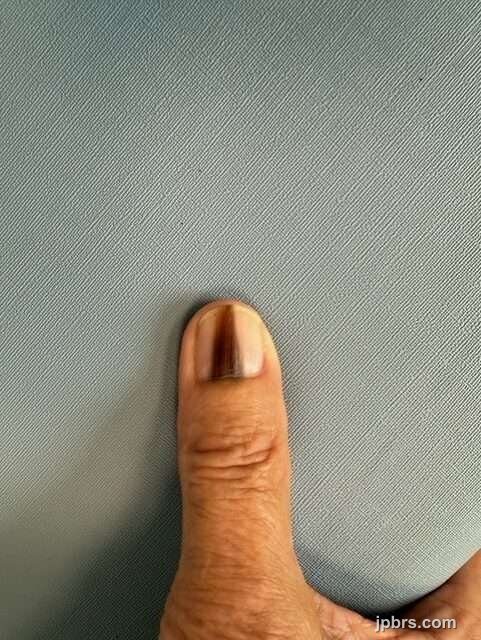
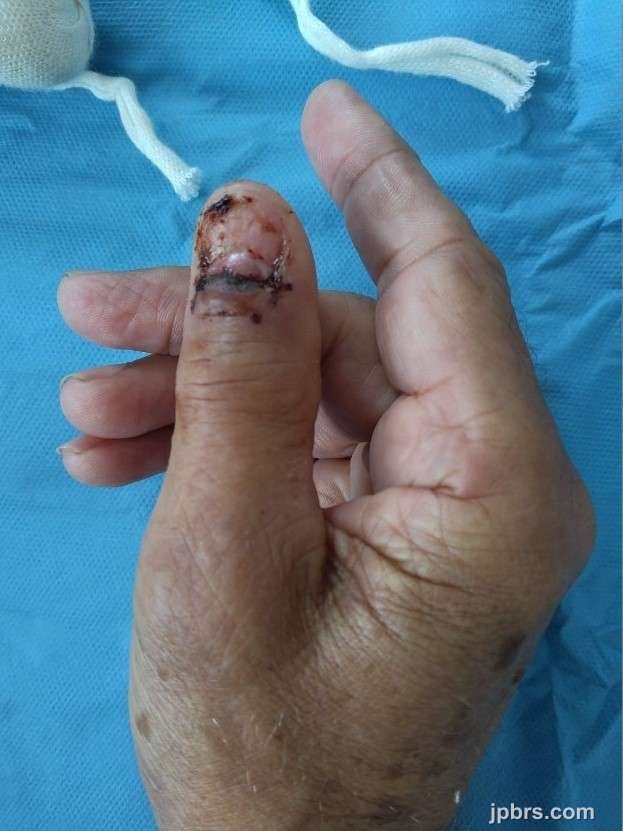 BeforeAfter
A 72-year-old man was referred to the department of plastic surgery and breast surgery at Zealands University Hospital, Roskilde, on suspicion of malignant melanoma under the nail of his right thumb.

Anatomy
The nail unit consists of:
•tNail matrix: Growth zone of the nail plate.
•tNail bed: Underlying tissue securing the nail plate to the finger.
•tNail plate: Keratinized structure forming the visible part of the nail.
•tNail folds (cuticle/eponychium): Surrounds the nail plate and protect against infection.

•tPreoperative skin antisepsis.
•tSterile draping (consider a surgical fenestrated drape).
•tPerform a digital nerve block at the base of the affected finger or. toe.
2

•tPrepare the tourniquet by cutting into the finger of a surgical glove proximally and distally.
3

•tApply a proximal tourniquet
4

5

•tConfirm adequate anesthesia.
•tIncise the nail fold on both sides of the pigmentation.
6

•tUndermine the nail fold to visualize the pigmented tissue using first a scalpel and then dissection scissiors.
7

•tA punch biopsy (preferably 3–4 mm) can be performed with or without removal of the nail plate. If the punch biopsy is performed without nail plate removal, then it is performed as shown below. Press down to the periosteum at the origin of pigmentation.
•tSubmit the nail plate, biopsy specimen, and any intervening tissue separately in separate pathology specimen containers and send to pathology.
•tAchieve hemostasis.
8

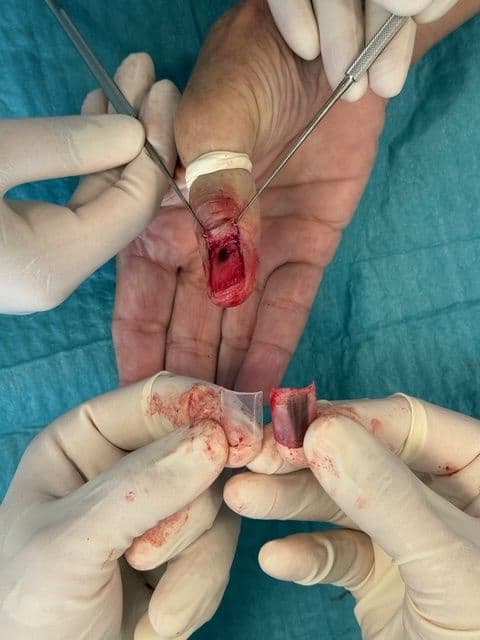
•tGrasp the free edge of the nail plate with a hemostat and avulse the nail plate with a twisting motion.
•tIf difficult to detach, perform blunt dissection using a curved dissection scissor beneath the nail plate along the nail groove.
•tSubmit the nail plate, biopsy specimen, and any intervening tissue separately to pathology.
9

•tWhen the nail plate is removed, a punch biopsy (preferably 3–4 mm) can be performed down to the periosteum at the origin of pigmentation.
10

•tAchieve hemostasis.
11

•tTrim a syringe barrel (typically 10 mL for fingers and toes 2–4; 20 mL for the great toe) to match the size of the nail bed, ensuring smooth, rounded edges.
12

13

•tCreate two holes at the proximal end using a needle.
14

•tSecure the customized nail splint to the nail fold using 4-0 Nylon sutures through the two holes.
15

•tSuture the incisions to nail fold with 4-0 Nylon sutures.
16

•tApply sterile dressing. For instance, a protective finger dressing or a gauze secured with micropore tape over the nail bed.
17
• Keep the area clean and dry.
• Apply sterile dressing and change as needed.
• Remove sutures and the temporary nail substitute after 14 days.
• Provide instructions regarding signs of infection and bleeding.
• Communicate histopathological results when available.
How to cite this article
Linnea Kristensen Ejiofor. Case 14 2026: Nail removal and punch biopsy - Subungual Melanoma. Journal of Plastic, Breast & Reconstructive Surgery. 2026.
Open access. © 2026 The Author(s). Published by the Journal of Plastic, Breast & Reconstructive Surgery. Copyright to this case is shared between the author(s) and the journal; authors may reuse their own case for education, presentations and social media.
Keep reading
Related cases
Case 20 2026: Staged Excision and Delayed Primary Closure of a large Nodular Basal Cell Carcinoma of the Anterior Scalp
Mikkel Halborg Sørensen, Nanja Gotland Sundstrup, Christian Lyngsaa Lang
Keywords: Basal cell carcinoma, scalp reconstruction, staged excision, primary closure, scalp biomechanics. Authors: Mikkel Halborg Sørensen, MD; Nanja Gotland Sundstrup, MD; Christian Lyngsaa Lang, MD. Institution: Department of Plastic Surgery and Burns, Rigshospitalet, Copenhagen University Hos-pital, Denmark Abstract A 48-year-old woman was referred with a non-radically excised nodular basal cell carcinoma of the anterior scalp complicated by wound infection and dehiscence. Re-excision with 3 mm margins to the galea was performed under local anesthesia. Given local inflammation and uncertain margin status, delayed reconstruction was planned pending histopathological confirmation. After clear margins were verified, controlled subgaleal undermining allowed tension-reduced primary closure. This staged strategy ensured oncologic safety while preserving hair-bearing scalp and avoiding unnecessary flap reconstruction. Patient medical history A 48-year-old woman was referred after incomplete excision of a nodular basal cell carcinoma (nBCC) of the anterior scalp performed in private plastic surgery practice. Histology demonstrated tumor involvement of the lateral margins, while the deep margin was free of tumor. Postoperatively, wound rupture and infection developed. Microbiology showed sparse growth of Staphylococcus aureus, and antibiotic therapy was initiated. The patient was otherwise non-smoking and healthy, with well-treated asthma, as her only relevant comorbidity. Before and After Patient examination Clinical examination revealed a 22 × 19 mm anterior scalp defect with limited perifocal erythema and minimal purulent discharge. No regional lymphadenopathy was palpable. Pre-operative considerations Initial histopathology demonstrated nodular basal cell carcinoma with focal lateral margin involvement and a clear deep margin, without perineural invasion or other high-risk features. In accordance with current recommendations for low-risk BCC, re-excision with 3 mm c
Case 22 2026: Superior Gluteal vessel: A rarely used recipient for free flap reconstruction of lumbosacral defects: a case report.
Tushar Dutta, Arun PS, Swati Sattavan
Keywords: Superior gluteal vessel, free flap reconstruction, lumbosacral defects Authors: 1. Tushar Dutta, Consultant Plastic Surgeon; 2. Arun PS, Consultant Surgical Oncologist; 3. Swati Sattavan, Consultant Surgical Oncologist; Institute: State Cancer Institute, Guwahati, Assam, India Abstract Lumbosacral defects that are too large for local flap reconstruction should be considered for microvascular free tissue transfer. However, lack of suitable recipient vessels in the area makes the task technically difficult. Options such as thoracodorsal and inferior gluteal vessels extended with vein grafts and AV loops have been described. Each option has its own drawbacks. Despite having a short course at its origin, the superior gluteal vessel is a viable alternative. We describe here a case where the vessel was dissected out with adequate length and used as a recipient for free flap reconstruction. Patient medical history The patient was a 41-year-old lady with no known comorbidities. She presented to us with a large lumbosacral mass that had been growing for one year. Before visiting our center, she had been operated twice at other institutions and had recurrences after each occasion. During the last three months the mass had started to grow rapidly and caused ulceration. There was no pain or fever. There was no neurological involvement of lower limbs. Patient had an ECOG status 1. Before and After Patient examination A 17x 22 cm mass was noted encompassing the left part of lumbosacral region and crossing the midline to the opposite side. The superior limit of the lesion was at the L3 vertebra and inferior extent was near the coccyx. Skin ulceration was noted at the center of the mass. On palpation, the mass was warm to touch, hard in consistency and immobile. Skin was fixed and fixity was also noted to the underlying muscle. No tenderness was elicited. Surrounding possible donor sites for flap harvest showed no scars. Pre-operative considerations Preoperative biopsy co
Case 23 2026: “Minimally Invasive Finger Amputation Using a Volar ‘Toilet seat’ Flap for Invasive Squamous Cell Carcinoma”
Claes Hannibal Killerich, Nikolaj Warming
Keywords: Squamous cell carcinoma; finger amputation; volar flap; local reconstruction; traction neurectomy; hand surgery. Authors: Claes Hannibal Killerich, Nikolaj Warming Abstract A 93-year-old woman presented with a chronic non-healing dorsal finger wound initially diagnosed as actinic keratosis. Repeat biopsy revealed invasive squamous cell carcinoma with joint and bone involvement. Due to the extent of invasion, distal amputation of the third finger was required. Reconstruction was performed using a volar “toilet seat” flap under digital nerve block to minimize surgical burden. The procedure achieved clear margins, preserved stump length, and avoided donor-site morbidity. This case highlights the importance of early re-biopsy of non-healing lesions and adapting surgical strategy to patient age, function, and comorbidity. Patient medical history A 93-year-old woman presented with a wound on the dorsal aspect of the proximal phalanx of the left third finger. A primary biopsy revealed actinic keratosis, and the lesion was treated several times with curettage and electrodesiccation by a private dermatologist. Despite repeated treatments under professional supervision, the wound failed to heal.Due to the persistent non-healing nature of the lesion, a repeat biopsy was performed, confirming the diagnosis of squamous cell carcinoma (SCC). The patient was referred to the Department of Plastic Surgery, Aalborg University Hospital, where a primary excision was performed with a 7 mm surgical margin. Histopathological examination demonstrated invasive tumor growth involving both joint and bone. The defect was subsequently reconstructed using a full-thickness skin graft. Before and After Patient examination The left third finger showed a healed full-thickness skin graft on the dorsal aspect of the proximal phalanx, covering the proximal interphalangeal (PIP) joint. There was no visible residual tumor, and no palpable lymphadenopathy in the left cubital fossa or axillary re