
Case 19 2026: Split Perforator Flaps for bilateral ankle defects: A modern microsurgical approach to preserve function and reduce secondary thinning operations
Luisa Lotter¹, Marta Jezierska¹, Ilja W. Käch¹, Volker J. Schmidt¹1
- 1Hospital St.Gallen, St.Gallen, Switzerland
Abstract
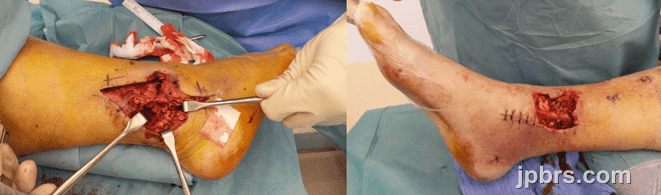
Keywords: Lower extremity; Orthoplastic Reconstruction; Split flap; microsurgery Authors: Luisa Lotter¹, Marta Jezierska¹, Ilja W. Käch¹, Volker J. Schmidt¹; ¹Department of Plastic Surgery and Handsurgery, HOCH, Health Ostschweiz, Cantonal Hospital St.Gallen, St.Gallen, Switzerland Abstract 46-year-old man presented with two full-thickness soft-tissue defects of the distal right lower leg (medial 7 × 4 cm, lateral 10 × 5 cm) with exposed tendons, osteosynthesis material, and bone after a Gustilo grade IIIb open tibial and fibular fracture. During initial orthopedic stabilization, interdisciplinary orthoplastic assessment and planning were performed. Because of exposed functional structures and two spatially separated defects with healthy anterior skin between them, microsurgical free-tissue reconstruction was chosen to provide stable coverage while preserving the anterior skin and preventing flap-related functional impairment. Reconstruction was achieved using a split anterolateral thigh (ALT) flap based on two independent perforators, enabling simultaneous coverage of both defects with a single vascular pedicle. Patient medical history The patient’s medical history was significant for type 2 diabetes mellitus, two-vessel coronary artery disease, and obesity. Before and After Patient examination Clinical assessment revealed two full-thickness defects at the distal lower leg: • medial defect: 7 × 4 cm with exposed tendons • lateral defect: 10 × 5 cm with exposed bone and osteosynthesis material Both wounds showed non-viable soft-tissue components requiring radical surgical debridement prior to reconstruction. An CT-angiography was performed, revealing a regular three-vessel supply to the affected lower right leg. Preoperative color-duplex-ultrasound was routinely performed to identify the ALT perforator pattern and to verify, if a two-perforator split ALT-fashion is possible. Due to our tertiary orthoplastic program final interdisciplinary reconstruction was schedule
Donor site in anterolateral thigh (ALT) free flaps: A systematic review of closure techniques and introduction of a management algorithm Chang, Chad et al. Journal of Plastic, Reconstructive & Aesthetic Surgery, Volume 105, 243 - 259Split anterolateral thigh free flaps for bilateral open fracture ankle defects: A one donor, two flap solution, Wilson, Elizabeth et al. JPRAS Open, Volume 46, 2025, Pages 61-64
 BeforeAfter
The patient’s medical history was significant for type 2 diabetes mellitus, two-vessel coronary artery disease, and obesity.

After removal of the negative pressure wound therapy (NPWT) dressing, the wound was thoroughly inspected, radically debrided, and sampled for microbiology. The osteosynthesis material was largely covered except for a small exposed segment. Concurrently, ligamentous and peroneal tendon reconstruction was performed to restore ankle stability. This ensured an adequately conditioned wound bed and a stable biomechanical environment prior to definitive microsurgical soft-tissue coverage.

Concurrently, ligamentous and peroneal tendon reconstruction was performed to restore ankle stability. Through an anterior longitudinal approach, the anterior tibial artery and its concomitant veins were identified and mobilized over a length of approximately 6 cm. Side branches were clipped, and the vessels were prepared for subsequent microsurgical anastomosis.
2

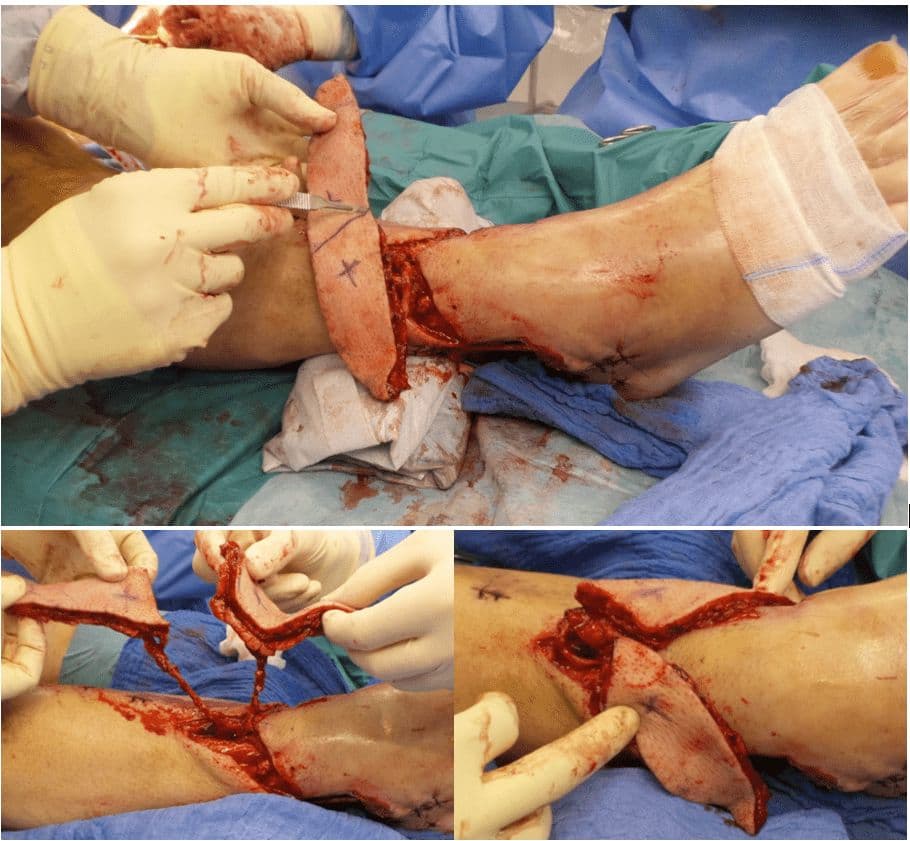
Simultaneously, a bipedicled anterolateral thigh (ALT) flap was harvested from the left thigh. The flap design was centered over the two dominant perforators to allow subsequent division into two equally sized skin islands (marked in green and blue). After fascial incision, two robust perforators with a long intramuscular course (approximately 12 cm) were identified.
The descending branch of the lateral circumflex femoral artery was dissected proximally to achieve adequate pedicle length and vessel caliber. Prior to flap transfer, perfusion of both distal flap segments was confirmed using indocyanine green angiography.
3

The pedicled flap was transferred to the lower-leg defect without torsion. Venous anastomoses were performed using a 2.0-mm coupler and an additional hand-sewn anastomosis to the two venae comitantes. An end-to-side arterial anastomosis to the anterior tibial artery was completed using interrupted microsurgical sutures (Dafilon 8-0). After systemic heparinization and clamp release, the flap demonstrated immediate and stable perfusion. The anastomotic site was reinforced with fibrin sealant.
The flap was subsequently divided between the two perforators, creating two spindle-shaped skin islands. One island was inset into the medial defect, whereas the second island was rotated to cover the distal lateral defect. Care was taken to avoid torsion or traction on both pedicles during inset.
4
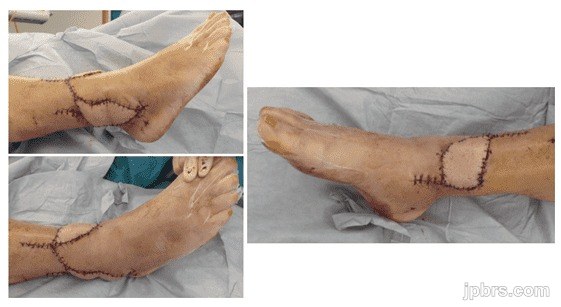
Both flaps were trimmed and inset tension-free using interrupted sutures. Final inspection confirmed excellent perfusion of both components. The donor site was reconstructed with a partial resorbable mesh reinforcement of the fascial defect and primary skin closure with drainage.
5
• Strict limb elevation and bed rest were maintained for five postoperative days. Flap perfusion was monitored hourly for the first 24 hours and at regular intervals thereafter.
• A structured dangling protocol was initiated from postoperative day 5 to gradually condition venous outflow.
• The patient was immobilized in a custom splint with protected partial weight-bearing of 15 kg for six weeks due to the underlying osteosynthesis. A pressure-relieving recess was incorporated over the flap to avoid compression and prevent equinus deformity.
• Low-molecular-weight heparin anticoagulation and intravenous antibiotics were administered according to institutional microsurgical protocol and adjusted to microbiological results.
• Compression therapy was continued for six months, with scheduled outpatient follow-up at regular intervals.
How to cite this article
Luisa Lotter¹, Marta Jezierska¹, Ilja W. Käch¹, Volker J. Schmidt¹. Case 19 2026: Split Perforator Flaps for bilateral ankle defects: A modern microsurgical approach to preserve function and reduce secondary thinning operations. Journal of Plastic, Breast & Reconstructive Surgery. 2026.
Open access. © 2026 The Author(s). Published by the Journal of Plastic, Breast & Reconstructive Surgery. Copyright to this case is shared between the author(s) and the journal; authors may reuse their own case for education, presentations and social media.
Keep reading
Related cases
Case 20 2026: Staged Excision and Delayed Primary Closure of a large Nodular Basal Cell Carcinoma of the Anterior Scalp
Mikkel Halborg Sørensen, Nanja Gotland Sundstrup, Christian Lyngsaa Lang
Keywords: Basal cell carcinoma, scalp reconstruction, staged excision, primary closure, scalp biomechanics. Authors: Mikkel Halborg Sørensen, MD; Nanja Gotland Sundstrup, MD; Christian Lyngsaa Lang, MD. Institution: Department of Plastic Surgery and Burns, Rigshospitalet, Copenhagen University Hos-pital, Denmark Abstract A 48-year-old woman was referred with a non-radically excised nodular basal cell carcinoma of the anterior scalp complicated by wound infection and dehiscence. Re-excision with 3 mm margins to the galea was performed under local anesthesia. Given local inflammation and uncertain margin status, delayed reconstruction was planned pending histopathological confirmation. After clear margins were verified, controlled subgaleal undermining allowed tension-reduced primary closure. This staged strategy ensured oncologic safety while preserving hair-bearing scalp and avoiding unnecessary flap reconstruction. Patient medical history A 48-year-old woman was referred after incomplete excision of a nodular basal cell carcinoma (nBCC) of the anterior scalp performed in private plastic surgery practice. Histology demonstrated tumor involvement of the lateral margins, while the deep margin was free of tumor. Postoperatively, wound rupture and infection developed. Microbiology showed sparse growth of Staphylococcus aureus, and antibiotic therapy was initiated. The patient was otherwise non-smoking and healthy, with well-treated asthma, as her only relevant comorbidity. Before and After Patient examination Clinical examination revealed a 22 × 19 mm anterior scalp defect with limited perifocal erythema and minimal purulent discharge. No regional lymphadenopathy was palpable. Pre-operative considerations Initial histopathology demonstrated nodular basal cell carcinoma with focal lateral margin involvement and a clear deep margin, without perineural invasion or other high-risk features. In accordance with current recommendations for low-risk BCC, re-excision with 3 mm c
Case 22 2026: Superior Gluteal vessel: A rarely used recipient for free flap reconstruction of lumbosacral defects: a case report.
Tushar Dutta, Arun PS, Swati Sattavan
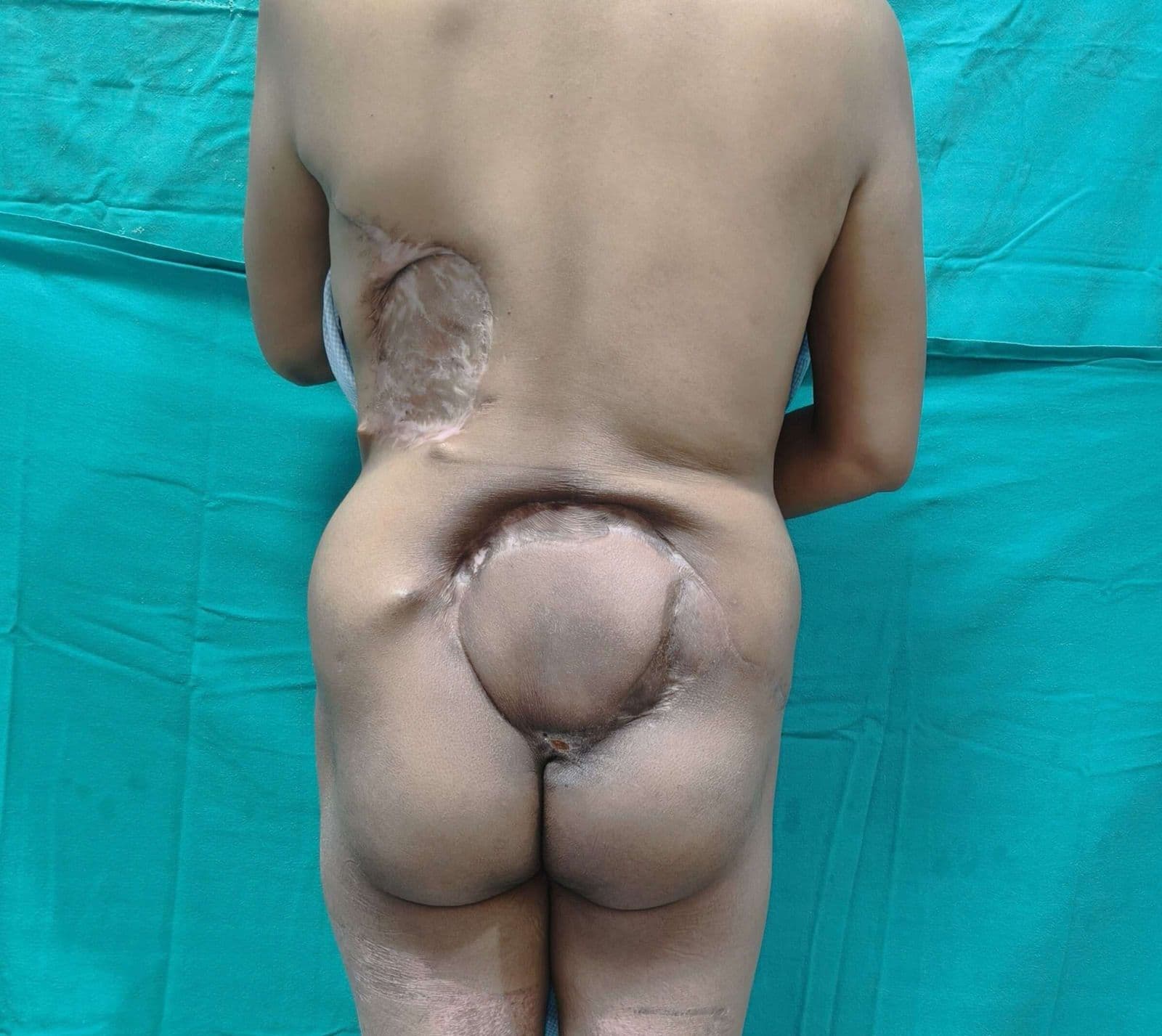
Keywords: Superior gluteal vessel, free flap reconstruction, lumbosacral defects Authors: 1. Tushar Dutta, Consultant Plastic Surgeon; 2. Arun PS, Consultant Surgical Oncologist; 3. Swati Sattavan, Consultant Surgical Oncologist; Institute: State Cancer Institute, Guwahati, Assam, India Abstract Lumbosacral defects that are too large for local flap reconstruction should be considered for microvascular free tissue transfer. However, lack of suitable recipient vessels in the area makes the task technically difficult. Options such as thoracodorsal and inferior gluteal vessels extended with vein grafts and AV loops have been described. Each option has its own drawbacks. Despite having a short course at its origin, the superior gluteal vessel is a viable alternative. We describe here a case where the vessel was dissected out with adequate length and used as a recipient for free flap reconstruction. Patient medical history The patient was a 41-year-old lady with no known comorbidities. She presented to us with a large lumbosacral mass that had been growing for one year. Before visiting our center, she had been operated twice at other institutions and had recurrences after each occasion. During the last three months the mass had started to grow rapidly and caused ulceration. There was no pain or fever. There was no neurological involvement of lower limbs. Patient had an ECOG status 1. Before and After Patient examination A 17x 22 cm mass was noted encompassing the left part of lumbosacral region and crossing the midline to the opposite side. The superior limit of the lesion was at the L3 vertebra and inferior extent was near the coccyx. Skin ulceration was noted at the center of the mass. On palpation, the mass was warm to touch, hard in consistency and immobile. Skin was fixed and fixity was also noted to the underlying muscle. No tenderness was elicited. Surrounding possible donor sites for flap harvest showed no scars. Pre-operative considerations Preoperative biopsy co
Case 23 2026: “Minimally Invasive Finger Amputation Using a Volar ‘Toilet seat’ Flap for Invasive Squamous Cell Carcinoma”
Claes Hannibal Killerich, Nikolaj Warming
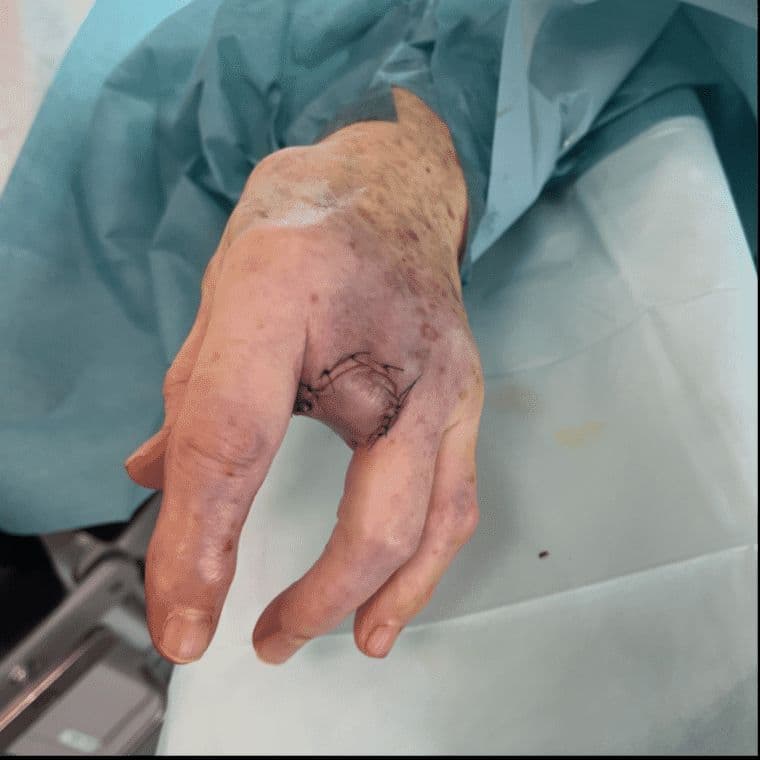
Keywords: Squamous cell carcinoma; finger amputation; volar flap; local reconstruction; traction neurectomy; hand surgery. Authors: Claes Hannibal Killerich, Nikolaj Warming Abstract A 93-year-old woman presented with a chronic non-healing dorsal finger wound initially diagnosed as actinic keratosis. Repeat biopsy revealed invasive squamous cell carcinoma with joint and bone involvement. Due to the extent of invasion, distal amputation of the third finger was required. Reconstruction was performed using a volar “toilet seat” flap under digital nerve block to minimize surgical burden. The procedure achieved clear margins, preserved stump length, and avoided donor-site morbidity. This case highlights the importance of early re-biopsy of non-healing lesions and adapting surgical strategy to patient age, function, and comorbidity. Patient medical history A 93-year-old woman presented with a wound on the dorsal aspect of the proximal phalanx of the left third finger. A primary biopsy revealed actinic keratosis, and the lesion was treated several times with curettage and electrodesiccation by a private dermatologist. Despite repeated treatments under professional supervision, the wound failed to heal.Due to the persistent non-healing nature of the lesion, a repeat biopsy was performed, confirming the diagnosis of squamous cell carcinoma (SCC). The patient was referred to the Department of Plastic Surgery, Aalborg University Hospital, where a primary excision was performed with a 7 mm surgical margin. Histopathological examination demonstrated invasive tumor growth involving both joint and bone. The defect was subsequently reconstructed using a full-thickness skin graft. Before and After Patient examination The left third finger showed a healed full-thickness skin graft on the dorsal aspect of the proximal phalanx, covering the proximal interphalangeal (PIP) joint. There was no visible residual tumor, and no palpable lymphadenopathy in the left cubital fossa or axillary re